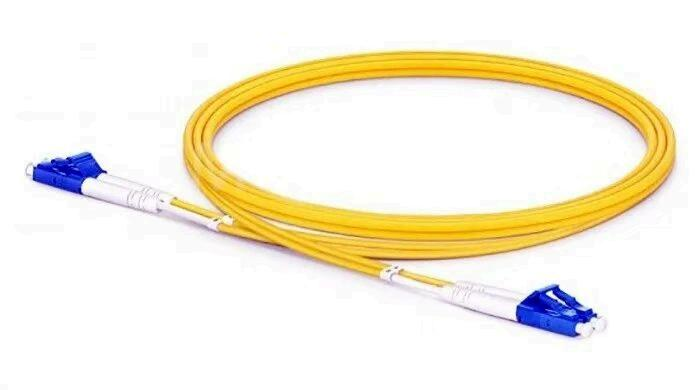

LC is commonly used for duplex (two-fiber) connections. MPO gathers multiple optical fibers into a single connector. MTP is US Conec’s branded MPO product, and SN offers a more compact duplex interface. The name of an interface does not directly determine data rate; selection also requires confirming the fiber count, end face, polarity, and optical specifications.
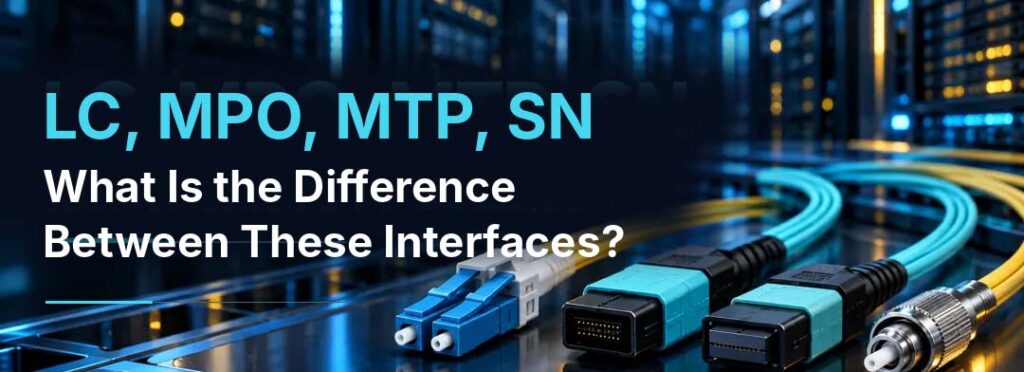
In an optical module quotation, LC, MPO, MTP, and SN look like four parallel interface types, but they do not actually sit at the same classification level. Understanding this is the way to avoid buying cables that look similar but cannot be connected correctly.
Contents
01 | LC: A Single-Fiber Plug That Can Be Paired into a Duplex
02 | MPO: One Plug Connecting Many Fibers
03 | MTP: A Branded Product Within the MPO Family
04 | SN: A More Compact Duplex Interface
05 | Same Connector, So Why Might It Still Not Work?
06 | When Selecting, Start with Equipment Requirements, Then Plan the Cabling
01 LC: A Single-Fiber Plug That Can Be Paired into a Duplex
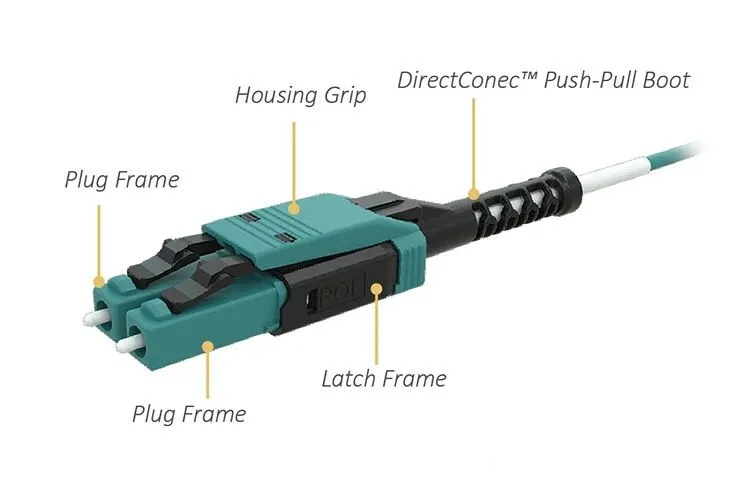
LC uses a 1.25 mm ceramic ferrule, and a single plug normally corresponds to one optical fiber. A common duplex LC is made by pairing two single-fiber plugs; in an ordinary two-fiber link, one fiber transmits and the other receives.
However, LC is not the same as two-fiber transmission. A module that uses a single-fiber bidirectional design can also use a single LC port. LC can be used with either single-mode or multimode fiber, depending on the product configuration. LC has a mature ecosystem, and patch cords, patch panels, and test tools are all quite common. Nor does LC imply low speed: a high-speed module that uses wavelength-division multiplexing can have multiple wavelengths share one pair of fibers, which is then connected through duplex LC.
02 MPO: One Plug Connecting Many Fibers
MPO uses a multi-fiber ferrule that gathers multiple optical fibers into one connector, so a single mating action connects many fiber cores. Common configurations include 12-fiber, 16-fiber, and 24-fiber versions, but products with different fiber-position layouts and keying cannot be mixed at will.
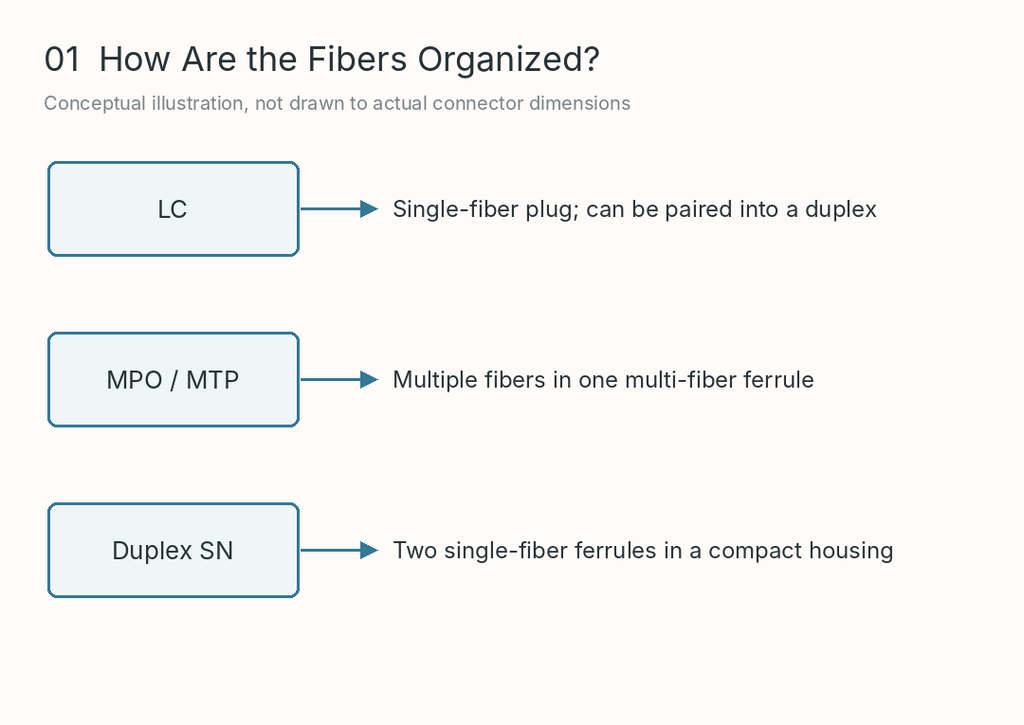
MPO is commonly used for parallel optical modules and high-density trunk cabling. The number of fiber positions in the connector does not necessarily equal the number of fibers a module actually uses. For example, some interfaces use an MPO-12 connector but use only 8 of its fiber positions. Guide-pin configuration must also be distinguished: mating normally requires one end with pins and the other without, to ensure precise alignment. Polarity determines whether each transmit end ultimately maps to the correct receive end. A plug that fits in does not mean the wiring relationship is correct.
03 MTP: A Branded Product Within the MPO Family
MTP is a registered trademark of US Conec, and its connector products belong to the MPO family. Therefore, MTP and MPO are not two entirely different, parallel interfaces. MPO describes the interface category, while MTP describes a branded product line within it. Some MTP PRO products come with companion tools that support field adjustment of polarity or guide-pin configuration, but these capabilities should not be assumed for all MTP products.
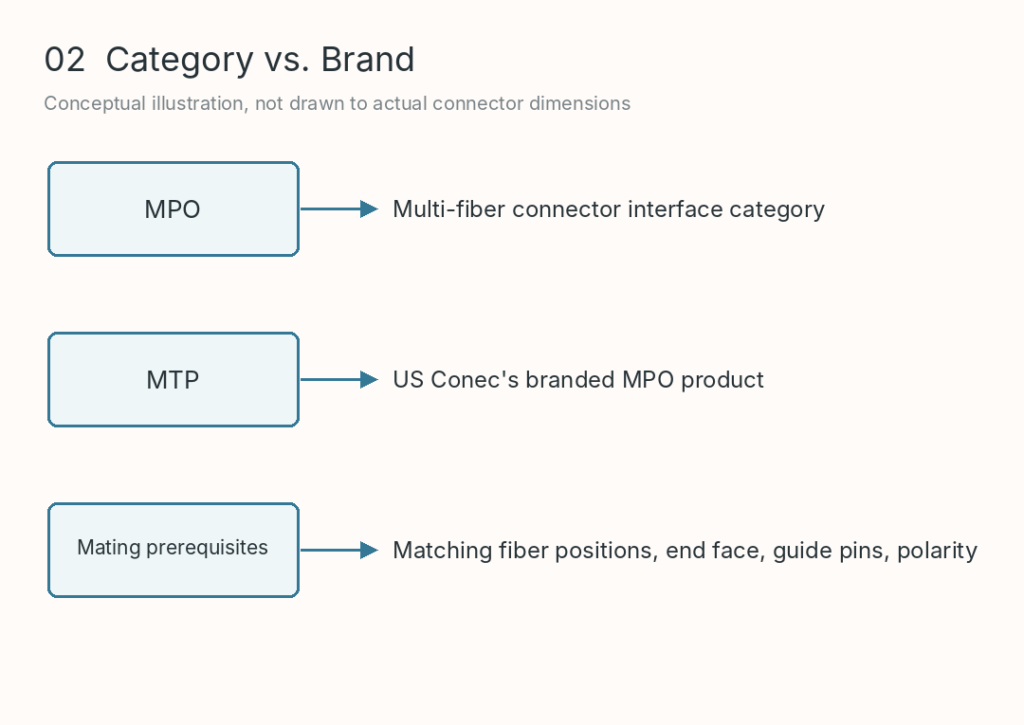
An MTP connector that meets the relevant interface requirements and has a matching configuration can be mated with other MPO products. The conditions here are important: fiber count, ferrule layout, end face, guide pins, and polarity must all match. When purchasing, you should also specify insertion-loss and return-loss requirements and review the test reports. A brand name cannot replace a complete engineering specification, nor can it alone prove that any two cables will be interoperable.
04 SN: A More Compact Duplex Interface
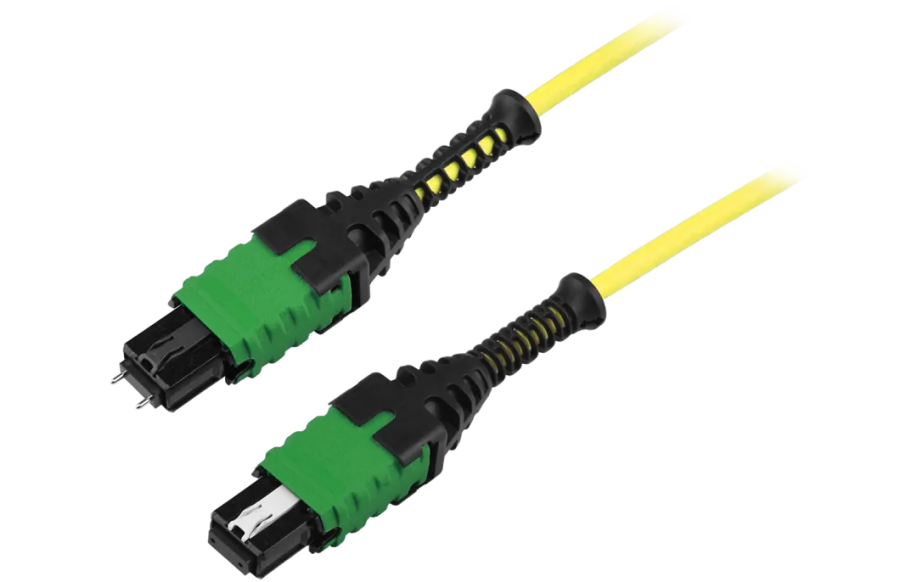
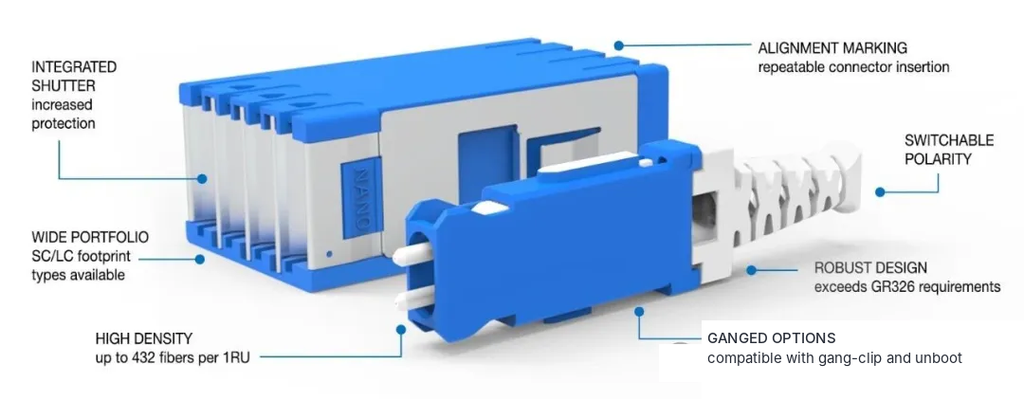
This article discusses the common duplex SN. It belongs to the very-small-form-factor connector category and uses two 1.25 mm ferrules in a compact housing, corresponding to two optical fibers. The main value of SN lies in panel density and independent duplex connections. A supporting module can arrange multiple SN ports so that different optical paths can be plugged and unplugged separately; the exact number and the channel mapping depend on the module design.
MPO gathers many fibers into one multi-fiber ferrule, whereas SN provides a compact duplex connection, so the two suit different cabling organizations. Even though SN and LC both use 1.25 mm ferrules, they cannot be plugged directly into each other. The housing, positioning, and interface structure differ, so matching patch cords or conversion solutions are needed. A conversion cable can only change the connection method; it cannot automatically convert wavelengths or protocols. Likewise, multiple SN ports do not mean the host necessarily supports arbitrary breakout, so the equipment mode, the module mapping, and the far-end specification must also be checked.
05 Same Connector, So Why Might It Still Not Work?
✓ First, the optical interfaces at the two ends may differ
Data rate, wavelength, modulation scheme, optical power range, and protocol requirements all need to match. The fact that two modules both have LC only indicates that the connection form may be the same.
✓ Second, the fiber and end face may not match
Single-mode and multimode fiber cannot be mixed just because the connectors are the same. UPC and APC end faces have different geometry and should not be mated directly. Color can help with identification, but specifications and markings remain the final authority.
✓ Third, the polarity may be incorrect
A duplex link must connect transmit to receive, and a multi-fiber link must be checked against the complete fiber-position map. Polarity names such as A, B, and C need to be understood in the context of the whole trunk, adapters, and breakout cables.
✓ Fourth, the loss or end-face condition may be out of tolerance
Adding connection points consumes the link budget, and contamination, scratches, and bending can also cause problems. Inspecting and cleaning before mating, then running applicable tests, is more effective than repeatedly plugging and unplugging.
06 When Selecting, Start with Equipment Requirements, Then Plan the Cabling
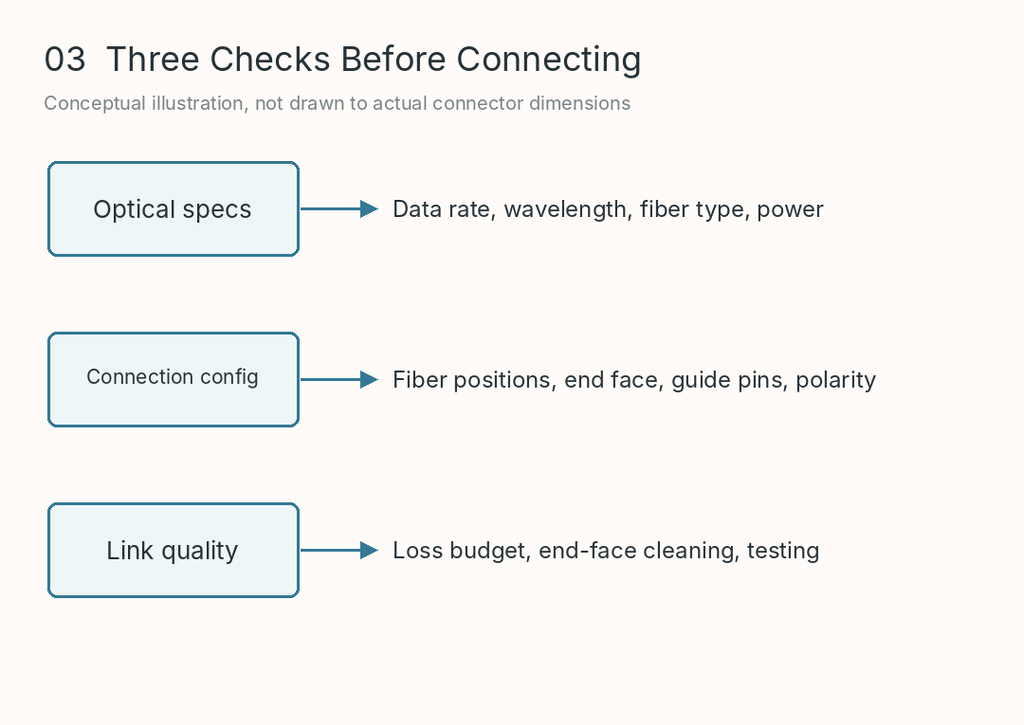
If the equipment provides duplex LC, plan around the corresponding two-fiber link configuration. If the equipment uses MPO, further confirm the fiber positions, end face, guide pins, and polarity. If the equipment uses SN, confirm in advance the availability of matching patch cords, cabling, cleaning tools, and test tools.
High-density cabling also calls for attention to maintenance. Multi-fiber connections raise density but make breakout and polarity management more complex; independent duplex connections make single-path operation easier but occupy correspondingly more panel space. You should not compare only the price of a single patch cord.
- LC is commonly used for single-fiber and duplex connections
- MPO is used for multi-fiber connections
- MTP is a branded product within the MPO family
- SN provides a compact duplex interface
The interface name answers only part of the question of how to connect. A complete link must also answer which fibers are being connected, which optical specifications apply, whether the loss is within budget, and whether the equipment at both ends supports it. Only when all of these conditions are met is the connection truly established.