
How to achieve efficient, stable and high-density optical fiber connections in high-speed optical communication scenarios such as data centers, 5G base stations and Fiber to the Home (FTTH)? The MPO connector is a key technology developed for this purpose. Serving as a “precision engine” in optical fiber networks, it features multi-fiber parallel transmission, quick plug-and-play and precise alignment, driving optical communication systems toward larger capacity and higher density.
I. What Is an MPO Connector?
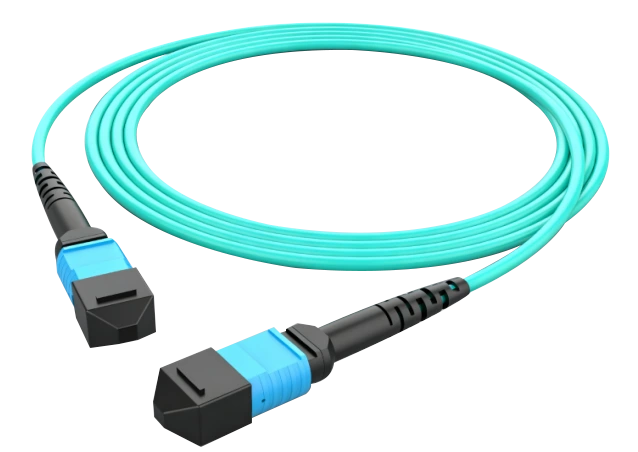
MPO, short for Multi-fiber Push On, is a high-density optical fiber connector enabling one-time coupling of multiple optical fibers. It is widely applied in data center cabling, interconnection of high-density optical communication equipment, FTTH and other scenarios, greatly improving cabling density and operation & maintenance efficiency.
II. Core Technology Analysis: How MPO Realizes Precise Alignment
1. Precision Ferrules and Matrix Arrangement
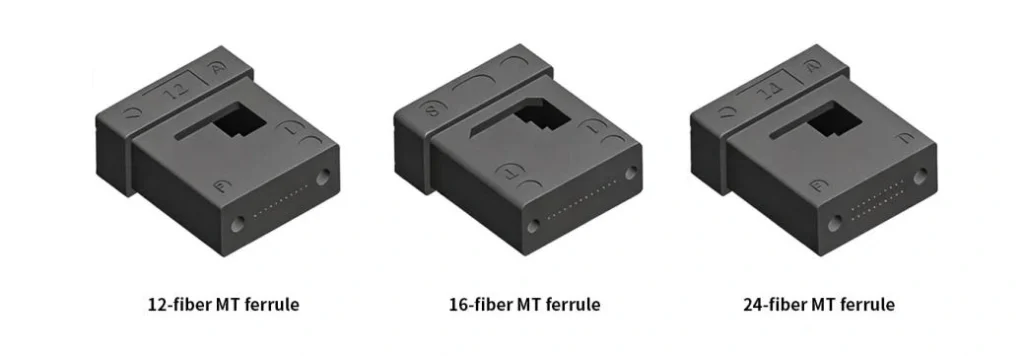
The core component of an MPO connector is the multi-fiber ferrule, generally made of ceramic. Embedded with 8, 12, 24 or more optical fibers in advance, the fibers are arranged in a strict matrix (e.g., 12 fibers arranged in 2 rows and 6 columns). The precision of the ferrule directly affects the insertion loss of fiber connections, with the deviation of fiber core diameter controlled at the micrometer level.
2. Guide Pin Positioning System
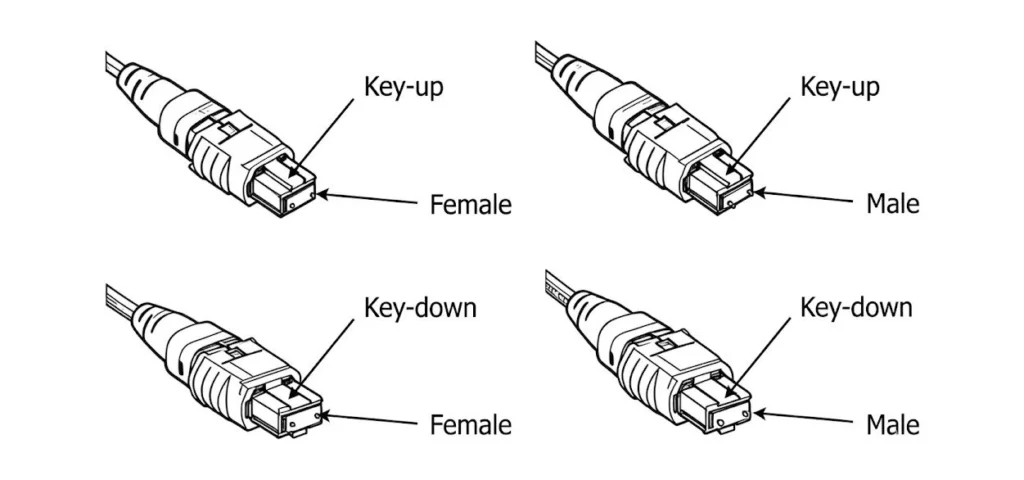
MPO connectors consist of male and female ends. The male end is fitted with two high-precision metal guide pins, while the female end has matching guide holes. During plugging and unplugging, the guide pins insert into the holes first to achieve accurate alignment between male and female ferrules, ensuring one-to-one correspondence of fiber cores and avoiding extra loss caused by misalignment.
3. Push-Pull Locking Mechanism
The connector housing adopts a push-pull buckle design. Simply push to complete coupling, and press the buckles on both sides to unlock and detach. This structure guarantees reliable connection and enables fast plugging and unplugging, well suited for frequent maintenance in high-density cabling environments.
4. Physical Contact End-face Technology
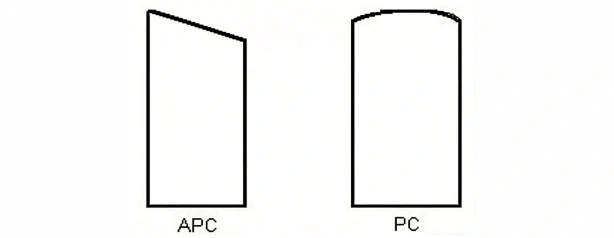
The ferrule end faces of MPO connectors are processed with physical contact polishing, namely UPC or APC. The UPC end face adopts a micro-spherical design, while the APC end face is an 8° angled spherical surface. Both designs ensure tight contact between fiber cores at two ends, reduce Fresnel reflection loss caused by air gaps, and realize low-loss transmission of optical signals.
5. Optical Signal Transmission Path
After the MPO connector is mated, optical signals from the transmitting-end optical fibers travel directly through the fiber cores to the cores of the receiving-end optical fibers. Its transmission principle is the same as that of conventional single-core optical fibers: light propagates via total internal reflection enabled by the refractive index difference between the fiber core and cladding. Unlike single-core fibers, MPO connectors support parallel transmission of multi-core optical fibers simultaneously, which greatly increases cabling density.
III. Major Application Scenarios
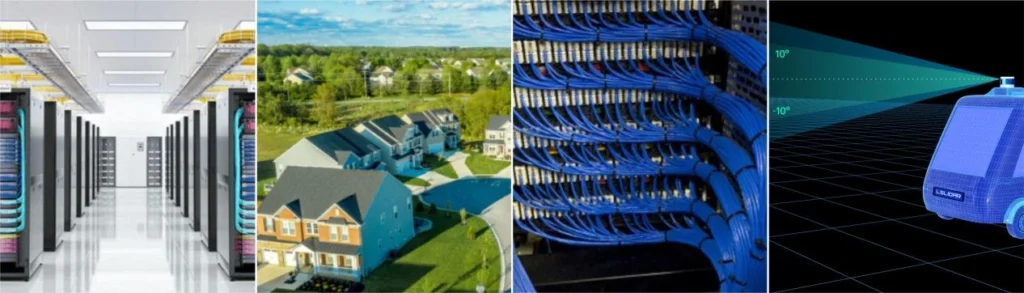
- Data Center Cabling: High-density optical fiber interconnection between servers and switches.
- FTTH & Campus Networks: Rapid deployment and connection of backbone optical cables.
- Internal Interconnection of High-Density Equipment: Compact connections for optical modules and optical distribution frames.
- High-end Polarization-Sensitive Systems: Polarization-maintaining MPO connectors for sophisticated fields including optical fiber sensing, LiDAR and quantum communication.
IV. FDC Connector Series
FDC MPO connectors deliver efficient, stable and user-friendly connection solutions for high-density optical communication scenarios, thanks to elaborate structural design and stringent quality control. Centered on customers’ practical demands, we provide customized products with various fiber counts and polarities, as well as full-process technical support. Every product is tailored for actual cabling scenarios and proven reliable in field applications.
Feel free to contact us for customized solutions or more information. FDC joins hands with you to build a future of high-speed interconnection in the optical communication industry!