
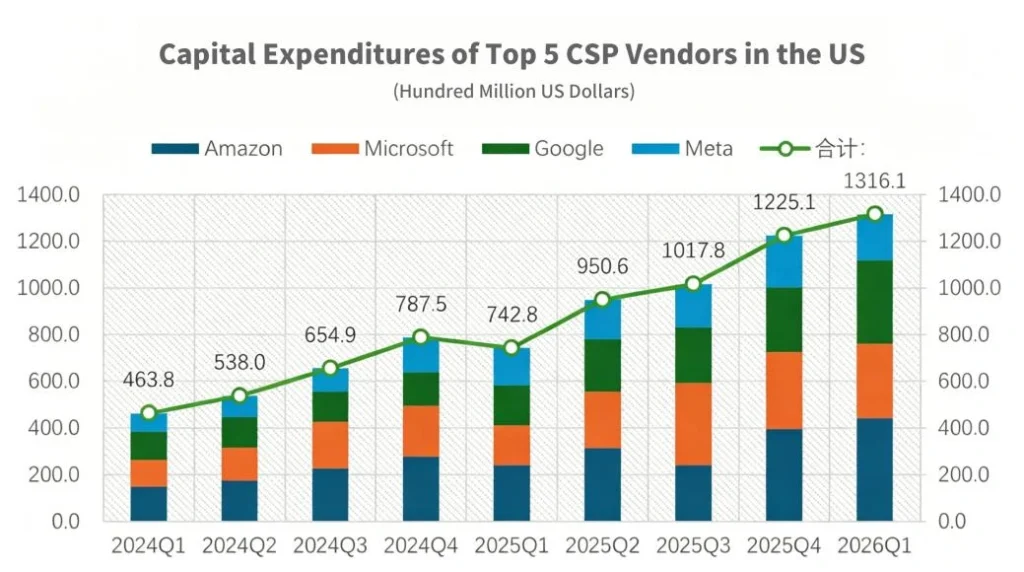
Over the past week, leading North American AI computing power giants including Amazon, Google, Meta and Microsoft released their Q1 2026 financial reports one after another, with all of them substantially raising their full-year capital expenditure plans. Investment in AI infrastructure has exceeded market expectations across the board.
Driven by the massive spending push on computing power by global cloud vendors, the optical communications sector officially kicked off an unprecedented super capacity expansion cycle in November 2025. For one thing, major global Communications Service Providers (CSPs) have continued to lift their capital expenditure guidance for 2026 and 2027. For another, NVIDIA has made strategic investments of $2 billion each in Lumentum and Coherent. It also forged a long-term in-depth strategic alliance with Corning, a leading optical fiber manufacturer. The model of locking up production capacity via long-term contracts has rapidly spread across the entire industrial chain.
Coupled with architectural revolutions brought by new technologies such as XPO, NPO, CPO and OCS, multiple industry trends have created a powerful synergy. Both the industrial community and capital markets have reached a unanimous consensus: the optical communications industrial chain is now engaged in an unprecedented race to expand production capacity. The duration and strength of the industry boom cycle have far outpaced earlier market forecasts.
I. CSPs Hike Capital Expenditure Outlook for the Next Two Years
In Q1 2026, the four major North American cloud vendors — Amazon, Microsoft, Google and Meta — posted a combined capital expenditure of $131.6 billion, representing a year-on-year surge of over 70%. All four companies have revised upward their full-year capital expenditure forecasts for 2026, with the total figure topping $710 billion. This scale is nearly double the full-year reading of 2025 and triple that of 2024.
More encouragingly, the robust growth in capital expenditure will not be a short-term spike, and strong expansion is set to continue into 2027. Google explicitly projected that its 2027 capital expenditure will jump sharply from the 2026 level. Microsoft acknowledged that its computing power infrastructure will remain constrained by production capacity throughout 2026 at the very least. Amazon has even extended its long-term order commitments and capacity lock-in agreements through 2028. The $710 billion capital expenditure budget for 2026 and the year-on-year growth rate above 70% fully prove that the global construction boom for computing power infrastructure is far from peaking.
Meanwhile, at the GTC and OFC conferences, NVIDIA and Google almost simultaneously stated that networking has become a major bottleneck for AI development.
II. Long-term Procurement Agreements Spread Across the Entire Optical Communications Industry Chain
NVIDIA has moved three times this year to secure supplies across the optical communications ecosystem, a strategy widely interpreted by insiders as a full-chain lock-in covering upstream optical chips, mid-stream optical fibers and downstream optical modules.
Back in March, NVIDIA announced separate strategic investments of $2 billion in Lumentum and Coherent, two leading optical chip makers. The deals came with long-term procurement commitments and production priority rights, with each contract valued at billions of US dollars. NVIDIA also secured priority access to Lumentum’s laser component capacity, and the two parties agreed to conduct joint R&D in silicon photonics technology. Lumentum later revealed that its order books are fully filled through 2028. Driven by strong market momentum, its Nasdaq-listed stock has surged by more than 1,500% over the past year.
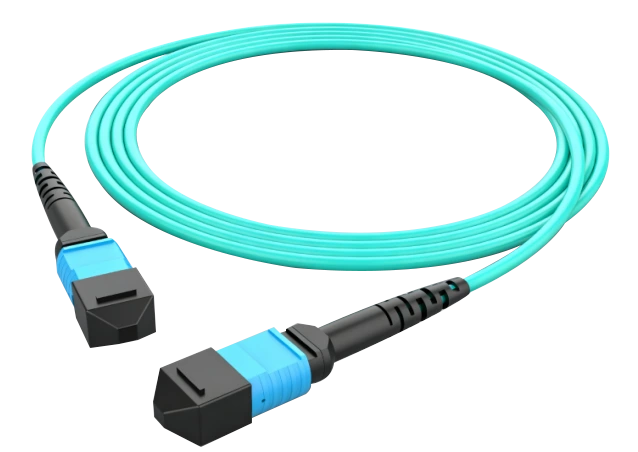
On May 6, NVIDIA signed a multi-year commercial and technical cooperation agreement with Corning, the top U.S. optical fiber manufacturer. Under the deal, Corning plans to scale up its optical connectivity solution capacity in the U.S. by 10 times and expand domestic optical fiber output by over 50%, which will involve building three new factories locally. This move signals the approaching mass production of Co-packaged Optics (CPO). The resulting demand aligns perfectly with three major application scenarios outlined by NVIDIA: scale-out deployment, in-rack scale-up deployment, and Data Center Interconnect (DCI). The coverage extends from fiber MPO connections to FAU connections for CPO and OCS systems.
NVIDIA’s series of moves has triggered a chain reaction throughout the industry. According to industry platform Fiber Online, since late November 2025, major optical module manufacturers have rushed to lock up capacity for Faraday rotators for medium and long-haul modules and CW lasers. DSP chip supply also requires coordination with end clients. Even production capacity for C-lenses, FAUs and MPO connectors has been fully reserved. The massive demand from AI computing power is accelerating the monopoly of production capacity by industry giants across the supply chain. In 2026, production capacity directly translates to order wins.
III. Shortages of Core Materials Trigger an Unprecedented Industry-wide Capacity Expansion Boom
The ongoing capacity expansion cycle stems from one core fact: AI-driven demand is growing far faster than industrial supply capacity. Behind the widespread expansion drive lies a hidden constraint — shortages of key upstream materials and core components.
Industry practitioners commented: “We have fulfilled orders for the whole of last year within the first quarter this year.” Procurement teams travel nonstop worldwide to secure capacity, while sales staff are stationed at production sites to oversee manufacturing and delivery. Since 2026, booming orders paired with insufficient capacity have become a common “pleasant trouble” for optical communications firms.
Supply shortages first emerged for Faraday rotators. As 800G and 1.6T optical modules gain rapid market penetration, demand for medium and long-haul modules has skyrocketed. As a core component protecting lasers, optical isolators have led to an extreme supply-demand imbalance for Faraday rotators. Apart from traditional global suppliers Coherent and Granopt, domestic players including Senyi Quantum, Fuzhou Crystal Technology and Feiruite have risen rapidly. Meanwhile, Japan’s Granopt has seen a decline in capacity utilization due to rare earth material regulations, further widening the supply gap. Leading optical module vendors have pre-emptively locked up all existing capacity of domestic manufacturers.
Shortages also plague high-end EML optical chips, silicon photonic modulators and CW lasers. The growing adoption of silicon photonic modulation solutions for 800G and 1.6T products has helped domestic high-end optical chips achieve technological breakthroughs and gain larger market share. Lumentum, Yuanjie Semiconductor, Sumitomo and other established players keep ramping up production. New suppliers of CW light sources such as Lianya have also had their capacity snapped up by major clients, as the industry enters a phase of accelerated qualification and mass deployment. Benefiting from its CW laser business, Yuanjie Semiconductor saw its revenue jump threefold year-on-year in Q1 2026, with net profit hitting 179 million yuan — nearly matching its full-year net profit of 191 million yuan in 2025.
Overseas leaders adopt even more aggressive expansion plans. All of Lumentum’s 200G EML chip capacity through 2028 has been fully pre-sold. Its Japanese plant expanded capacity by 12 times within two years, yet supply still falls short of demand. InP chips face slow capacity ramp-up due to long production cycles. Corning aims to boost its U.S. optical connectivity capacity tenfold and expand optical fiber output by over 50%, with orders booked all the way to 2030. Coherent stated clearly that 100% of its data center-focused capacity for 2026–2027 is fully reserved, and production slots for high-end customized products are scheduled until late 2028.
Major Japanese cable manufacturers are also rolling out large-scale capacity expansion. Sumitomo Electric Industries plans to increase its MT ferrule capacity to seven times the level of fiscal 2024. Fujikura continues to expand production of optical fibers and connectors, while Furukawa Electric has mapped out substantial capacity growth for optical components and high-density optical cables.
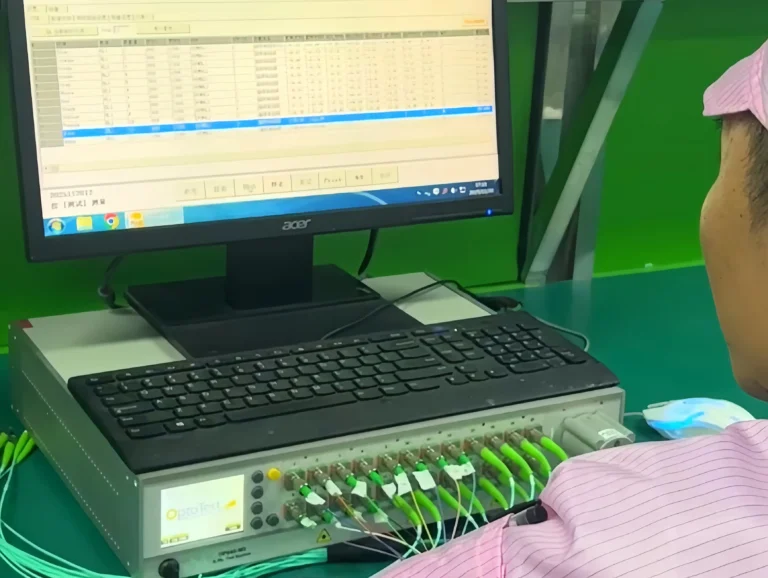
Long-term supply agreements have also rippled down to mid-stream equipment and component suppliers. Orders for optical modules, FAs, automatic lens coupling equipment and die attach machines have hit record highs. Supporting parts including linear motors, sliding tables and guide rails are in short supply. Leading enterprises are also purchasing spectrum analyzers and other testing equipment globally in bulk. Automated equipment makers noted that clients now place orders for hundreds or even thousands of units at a time — a volume equivalent to their total annual shipments back in 2023. The lead time for equipment components has extended to two months. Most equipment firms have seen their orders multiply, yet capacity expansion still cannot keep pace with surging new orders.
Demand for optical modules has exploded dramatically. According to research by C&C, global shipments of 800G and higher-speed optical modules reached around 24 million units in 2025, and are projected to climb to 56 million units in 2026, representing a year-on-year increase of 2.3 times. Three top vendors started mass production and delivery of 1.6T optical modules in 2026, with full-year procurement volume reaching 20 million units, a tenfold increase from 2025. Amid the severe supply-demand mismatch, companies like Eoptolink and TFC Co., Ltd. admitted that material shortages dragged down their performance growth in Q1 2026, reflecting the severity of the supply crunch.
IV. Coexistence of Pluggable, OCS and CPO: Diversified Optical Interconnection Architectures
As showcased at OFC 2026, while traditional pluggable optical modules are undergoing vigorous capacity expansion, a profound technological architecture revolution is underway. CPO continues its long-term evolution, Optical Circuit Switching (OCS) gains rapid traction, XPO becomes a hot industry topic, and NPO is regarded as a more practical interim solution. New optical interconnection technologies are moving from conceptual design to large-scale deployment, delivering diversified solutions for various scenarios in computing hubs.
Multiple technical paths are advancing in parallel. NVIDIA and Broadcom are pushing for the commercialization of CPO. NVIDIA forecasts that CPO will enter large-scale volume production from the second half of 2027 to 2028, which also extends the lifecycle of traditional pluggable modules. Meanwhile, conventional pluggable modules keep making breakthroughs in power density and power consumption, and the iteration of 400G per wavelength technology further sustains the prosperity of this mature track. In addition, the evolution of computing architecture from scale-out to scale-up has generated new demand for NPO and XPO, facilitated cross-domain scale-across scenarios, and driven robust growth in demand for ZR-series long-haul optical modules.
Another key industry trend is that OCS has evolved from Google’s exclusive solution into an industry-wide consensus. As AI clusters scale up to tens of thousands or even hundreds of thousands of GPUs, traditional optoelectronic switching architectures are constrained by excessive power consumption, high latency and limited bandwidth. By contrast, OCS can reconfigure optical paths directly at the physical layer without frequent photoelectric conversion, featuring low power draw, ultra-low latency and multi-rate compatibility. Domestically, the industry has also received policy support: in its Universal Computing Power Initiative launched in April 2026, China’s Ministry of Industry and Information Technology explicitly promoted the deployment of all-optical switching (OCS) technology.
On the demand side, Lumentum’s pending OCS orders have reached $400 million. Across the industrial chain, major optical module players including TeraHop (overseas arm of Innolight) and Eoptolink unveiled their OCS switch products for the first time at OFC 2026. Layout in next-generation optical interconnection technology has become a must for leading enterprises.
V. Capital Floods In: A Long-term Boom or Short-term Bubble?
“A single production line costs over 100 million yuan, so we have to rely on financing to expand capacity.””Clients only accept immediate available capacity and refuse forward delivery schedules.””Top customers require us to reserve half of our total capacity, making supply-demand balance extremely difficult.”
The AI-fueled capacity landscape has completely reshaped the industry’s traditional development logic. In the past, companies expanded production gradually based on confirmed orders. Today, production capacity equals orders, forcing enterprises to raise funds for aggressive expansion. Optical communications has thus become a core investment track in the capital market. Since 2026, IPOs, private placements and industrial mergers & acquisitions have been frequent, marking an obvious trend of massive capital inflows.
In primary equity investment and M&A, assets across the entire optical communications chain — covering optical modules, optical chips, production equipment and testing instruments — have become sought-after targets for cross-industry capital. Listed companies hold distinct advantages: they can ramp up capacity rapidly with strong capital support and sustain R&D for high-end new products, further reinforcing the pattern of “the strong getting stronger”.